


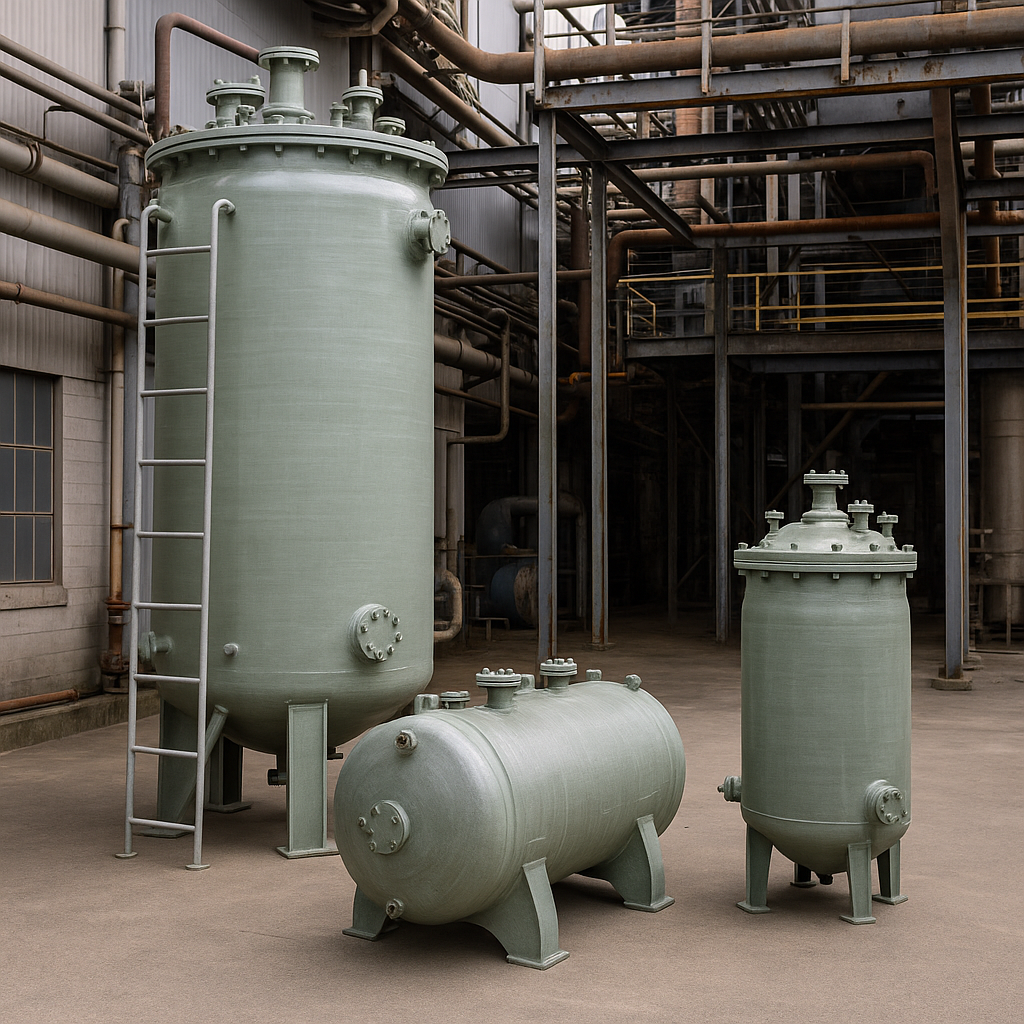
High-Performance, Corrosion-Resistant Reactors for Industrial Chemical Processing
Reconsky Fiber Glass Pvt. Ltd. offers an extensive range of FRP Reactors designed to meet stringent industrial standards for chemical processing, pharmaceutical manufacturing, wastewater treatment, and other process industries. Built using advanced fiberglass reinforced plastic technology, these reactors deliver superior corrosion resistance, excellent mechanical strength, durability, and operational safety.
What is an FRP Reactor?
An FRP Reactor is a specialized vessel manufactured from layers of fiberglass reinforcement embedded in a thermoset resin matrix such as vinylester or epoxy. This composite construction provides outstanding chemical resistance while remaining lightweight with high tensile strength. Reconsky FRP reactors are custom-fabricated using filament winding and hand layup techniques, with options for agitation systems, heating or cooling jackets, and process instrumentation to optimize reaction performance.
Features & Advantages
Superior Chemical Resistance
Resistant to acids, alkalis, organic solvents, and corrosive media, ensuring long-term reliability without material degradation.
Exceptional Mechanical Strength
Filament winding technology provides excellent pressure tolerance, impact resistance, and dimensional stability.
Custom Sizes & Capacities
Available in capacities from 1,000 liters to 10,000 liters and above, with customized dimensions and configurations.
Thermal & Corrosion Stability
Performs reliably across wide temperature ranges and aggressive chemical environments.
Smooth Internal Finish
Non-porous interior surface allows easy cleaning and prevents contamination or product build-up.
Automation & Control Ready
Compatible with manual or semi-automatic operation, including impellers, mixers, and PLC-based controls.
Lightweight & Easy Installation
Composite construction minimizes structural load and simplifies transportation and installation.
Standards Compliance
Designed and manufactured in accordance with BS 4994 and ASME RTP-1 standards for safety and performance.
Typical Applications
- Chemical and pharmaceutical batch processing
- Polymerization, copolymerization, and specialty chemical production
- Wastewater treatment and effluent processing
- Food, beverage, and biotechnology manufacturing
- Pilot plants and research-scale reactors
Technical Specifications
- Capacity Range: 1,000 to 10,000+ litres
- Material: Fiberglass Reinforced Plastic (FRP)
- Resin Type: Vinylester, Epoxy, Polyester
- Design Pressure: Up to 10–15 bar
- Operating Temperature: Typically -20°C to +100°C
- Shape: Cylindrical, Vertical
- Surface Finish: Smooth, corrosion-resistant inner lining
- Automation Grade: Manual, Semi-automatic
- Compliance: BS 4994, ASME RTP-1
- Color: Standard grey or as per customer requirement
Why Choose Reconsky FRP Reactors?
Reconsky brings decades of expertise in manufacturing high-performance FRP reactors that deliver consistent quality and long service life. Our reactors are engineered to meet exact process and space requirements, fabricated using premium materials and advanced winding techniques, and supported by comprehensive design, installation, and after-sales services. The result is a cost-effective, environmentally safe reactor solution that enhances operational efficiency.
Frequently asked questions
An FRP reactor is a process vessel manufactured from fiberglass reinforcement combined with corrosion-resistant resins such as isophthalic, bisphenol, vinyl ester, or epoxy systems. It is used for chemical reactions, mixing, or holding aggressive process media under controlled conditions. Unlike MS reactors, FRP reactors do not corrode in most acid and alkali environments, reducing contamination, wall thinning, and frequent relining or repainting. Compared to glass-lined steel, FRP eliminates risks of glass chipping, thermal shock damage, and expensive repair cycles. Being much lighter than metallic vessels, FRP reactors also reduce structural load requirements. For many non-very-high-pressure and non-very-high-temperature chemical processes in Gujarat, FRP reactors offer an excellent balance of chemical resistance, cost efficiency, and long-term performance.
FRP reactors are best suited for medium-pressure and moderate-temperature processes involving acids, alkalis, brine, etchants, pickling solutions, and many organic or inorganic liquids, subject to resin compatibility. They are widely used for reaction, neutralisation, mixing, and holding operations in chemical manufacturing, pharma intermediates, dyes and pigments, textile auxiliaries, and ETP neutralisation systems. For pickling and surface-treatment duties, FRP reactors safely handle hydrochloric, sulphuric, and mixed acids without the corrosion and leakage problems common in MS equipment. In water treatment and speciality chemical blending, the smooth and inert FRP surface minimises contamination and product build-up. Processes involving extremely high pressures or very high temperatures remain better suited to alloy or glass-lined reactors, but a wide range of ambient-to-moderate services can be reliably handled by FRP.
FRP reactors can be supplied in vertical or horizontal configurations, with flat, dished, or conical bottoms depending on process and drainage requirements. Typical capacities range from a few hundred litres for pilot or small-batch applications to tens of thousands of litres for bulk production. Designs may include manholes, baffles, customised nozzle layouts, sight glasses, and internal linings tailored to specific reaction or mixing duties. Agitation can be provided using top- or side-mounted mixers with appropriate shaft sealing and structural supports. In certain designs, metallic agitator components are combined with FRP-lined wetted zones to balance mechanical strength with chemical resistance. External supports, platforms, ladders, and instrumentation can be integrated into a complete reactor system matched to the plant layout.
FRP reactors are not intended for very high-pressure or very high-temperature services where metallic or glass-lined reactors are required. Design pressure and temperature must be clearly specified so that laminate thickness, resin selection, and safety factors are chosen correctly. Highly oxidising chemicals or certain solvent systems may require specialised resin grades or dual-laminate constructions. Nozzle loads, agitator loads, and thermal cycling effects must be carefully evaluated to ensure proper placement of stiffeners and supports and to avoid local overstress. When these engineering factors are addressed in accordance with recognised standards and experience, FRP reactors can safely replace MS or rubber-lined reactors in many medium-duty chemical applications.
FRP reactors significantly reduce corrosion-related maintenance, leakage risk, and downtime compared to MS or rubber-lined vessels. Their low weight reduces transportation, lifting, and structural steel costs, especially in multi-storey plants and brownfield expansions. Smooth, chemically inert internal surfaces minimise product contamination and simplify cleaning between batches, improving productivity and batch consistency. Over the equipment lifecycle, fewer relining jobs, reduced repainting, and lower unplanned shutdowns result in a lower total cost of ownership. For Gujarat’s chemical clusters such as Ankleshwar, Vapi, Dahej, and surrounding regions, FRP reactors are a reliable and sustainable solution wherever process conditions suit composite construction.